Our Products
Professional rehabilitation product line providing comprehensive solutions for patients with lower limb disabilities.
RTRT Hot Land Lower Limb Mold Library
Quality emerges from quantitative change.
Latest statistics as of 2026, 5
Full-dimensional compatibility
Lower-limb abnormalities in neurological disorders: 511 symptom combinations abstracted into four categories
Scientific classification, precise matching — just as there was no classification concept for diabetes 25 years ago, we have now established a Type I, II, III, and IV classification system.
Lower-limb abnormalities in neurological disorders: 511 symptom combinations abstracted into four categories
Scientific classification, precise matching — just as there was no classification concept for diabetes 25 years ago, we have now established a Type I, II, III, and IV classification system.
| Fractal | Product Examples | Indications | Before & After | |
|---|---|---|---|---|
| Before wearing | After wearing | |||
Type I Simple ankle plane | Rear ankle cutout (4 combinations on {1}) | Foot inversion/eversion correctable to neutral position manually, foot drop, no severe Achilles tendon contracture, muscle tone within grade 2. | 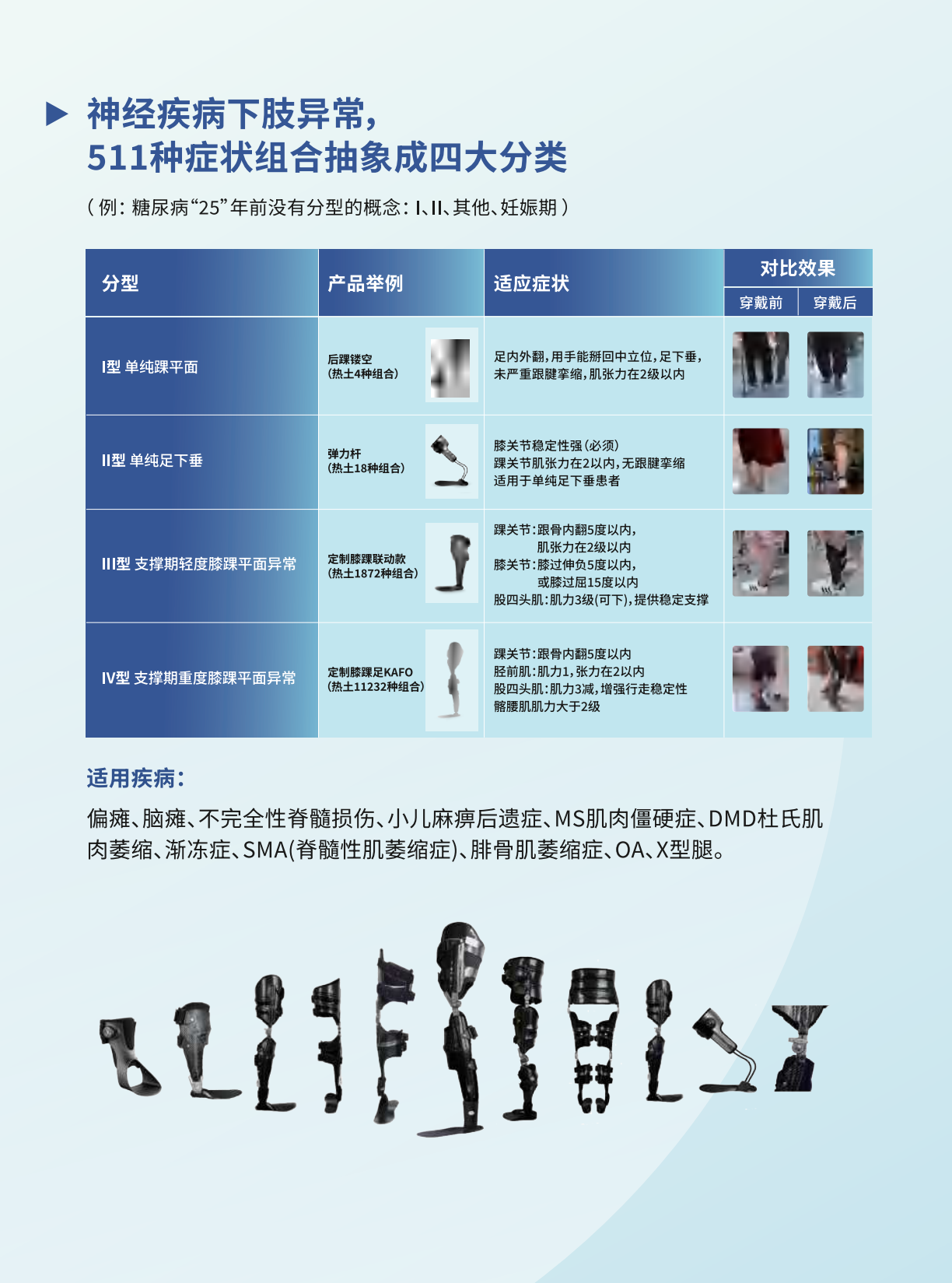 | |
Type II Simple foot drop | Elastic Rod (18 combinations on {1}) | High knee stability (required) Ankle muscle tone within 2, with no Achilles tendon contracture. For patients with simple foot drop | | |
Type III Mild frontal plane knee-ankle abnormality during the support phase | Customized Knee-Ankle Linkage Model (1872 combinations on {1}) | Ankle: Calcaneal varus within 5 degrees, muscle tone within grade 2. Knee: Hyperextension within 5 degrees or hyperflexion within 15 degrees Quadriceps: Muscle strength grade 3 (weight-bearing allowed), providing stable support. | | |
Type IV Severe knee-ankle plane abnormalities during the support phase | Custom KAFO (11232 combinations on {1}) | Ankle: Calcaneal varus within 5 degrees Anterior tibialis: muscle strength 1, tension within 2 Quadriceps: Muscle strength reduced, compromising walking stability. Iliopsoas muscle strength greater than 2 grade | | |
Indications
Oneneurogenic cause
Brain Disorders
Damage to brain nerve cells caused by intracerebral hemorrhage, cerebral ischemia, cerebral palsy, traumatic brain injury, and other conditions leads to foot drop, foot inversion, knee hyperextension, knee hyperflexion, and varying degrees of increased muscle tone in different parts of the lower limbs.
Lumbar spine disorders
When the lumbar intervertebral disc herniates, the spinal canal narrows, or the sciatic nerve is compressed, inflammation or pressure on the nerve root causes leg pain and weakness that worsens during walking (known as neurogenic claudication).
Spinal cord lesion
Spinal cord injury, tumors, or multiple sclerosis can impair lower limb motor function, leading to gait instability or dragging.
Peripheral neuropathy
Nerve damage caused by conditions such as diabetes or alcoholism can lead to reduced sensation in the feet or muscle atrophy, affecting walking coordination.
TwoVascular causes
Peripheral Arterial Disease
When arteries are narrowed or blocked, limb ischemia causes intermittent claudication, characterized by aching and coldness in the lower limbs after walking, which eases with rest.
Thrombus or embolism
Acute arterial embolism or deep vein thrombosis can cause sudden leg swelling and pain, potentially impairing the ability to walk in severe cases.
Vasculitis or Raynaud's disease
Vasospasm or inflammation can cause temporary limb ischemia, affecting mobility.
ThreeMusculoskeletal abnormalities
Arthritis
Osteoarthritis or rheumatoid arthritis of the hip and knee joints can cause joint stiffness, pain, and limit stride length and walking speed.
Trauma or deformity
Structural issues such as non-healed fractures, ligament injuries, congenital hip dislocation, or leg length discrepancy can directly cause limping.
Muscular Diseases
Muscular dystrophy, myositis, or muscle strains can lead to decreased strength and impaired limb coordination.
FourOther reasons
Infection or inflammation
Infections such as osteomyelitis and pyogenic arthritis can cause localized redness, swelling, heat, and pain, leading to a protective limp.
Tumor
When bone or soft tissue tumors compress nerves or destroy bone structures, they may cause pain and restricted mobility.
Metabolic Diseases
Osteoporosis, gout, or osteomalacia caused by vitamin D deficiency may affect bone strength and walking ability.
RTRT Hotland Rehabilitation Product Line: From Type I to Type IV, offering 11232 personalized combination options
China's first domestically developed smart KAFO lower limb
Innovative Technology, Leading Rehabilitation – Rhythmic Beat Smart Knee-Ankle-Foot Orthosis
Annual Meeting of the Beihai Rehabilitation Assistive Devices Application Committee
2024 years
China's first domestically developed smart KAFO lower limb, "Rhythm Beat," makes its debut, showcasing China's innovative breakthroughs in the field of intelligent rehabilitation assistive devices.
Shanghai PT Annual Meeting
2024 years
Invited to exhibit again that year, showcasing the innovative technology and clinical applications of our smart KAFO to physical therapy professionals nationwide.
The "PulseBeat" smart KAFO provides intelligent, personalized rehabilitation support for patients with severe knee-ankle gait abnormalities through precise gait analysis and real-time feedback.
Price Details
Transparent pricing, personalized plans — tailored product and service combinations based on your specific needs.
Assess first, serve later: deeply understand you to deliver expected short-, medium-, and long-term results.
Gather comprehensive information including disease type, symptoms, duration of onset, age, weight, mobility status, muscle condition, joint range of motion, balance ability, gait analysis, pain level, psychological state, family support, rehabilitation goals, treatment history, complications, imaging results, neurological assessment, activities of daily living (ADL), and social participation. Based on your specific situation, we will establish short-term, mid-term, and long-term recovery objectives.Short-term goals rely on service commitments, mid-term goals on case accumulation, and long-term goals on brand equity.
For patients with mild symptoms requiring only basic support
For moderate symptoms requiring personalized customization and ongoing guidance
For severe symptoms requiring complex equipment and long-term monitoring.
For specific conditions and symptoms; professional evaluation required to determine treatment plan
💡What's Included in the Price
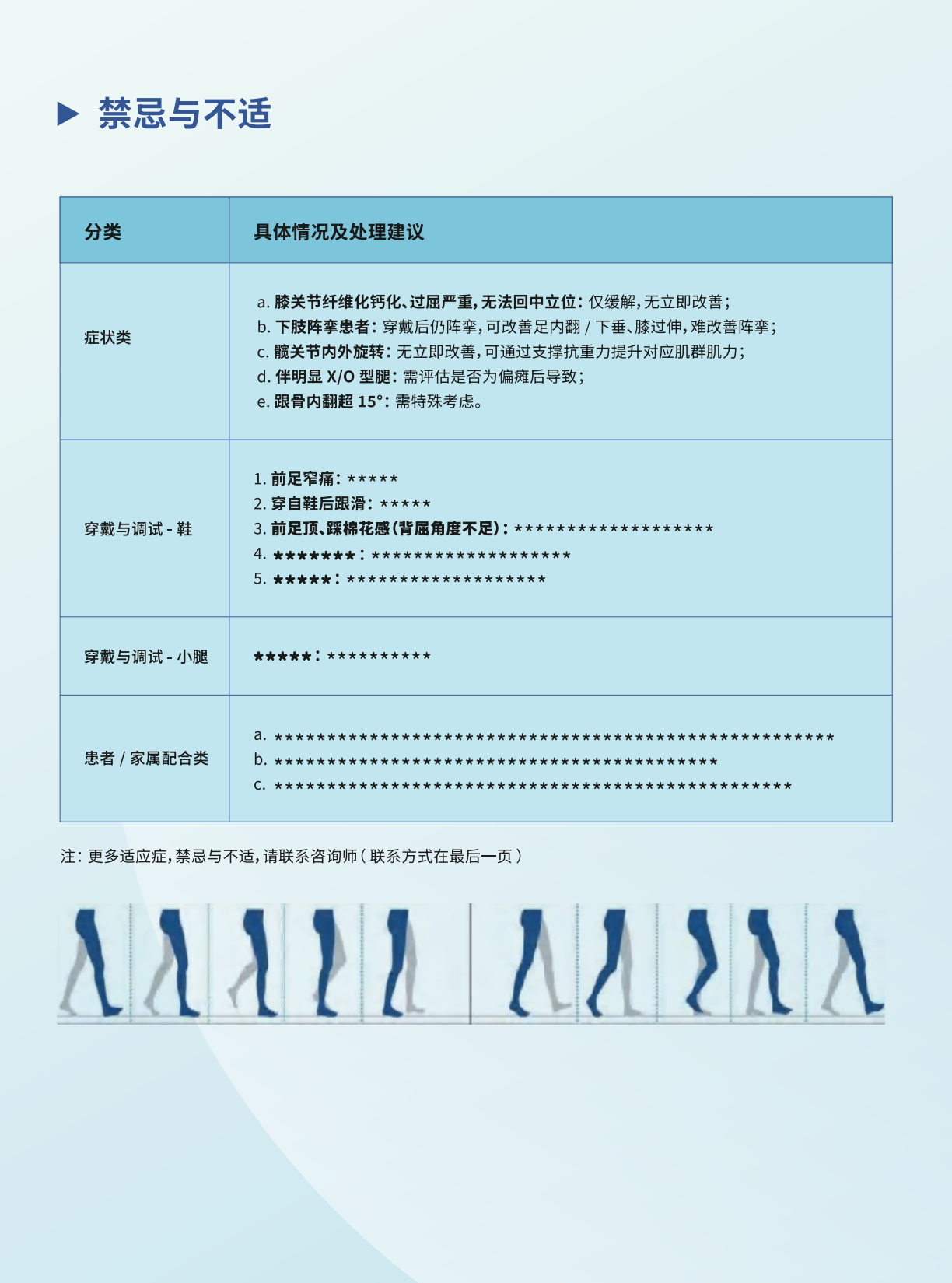
Contraindications and Warnings
Science-based understanding, realistic expectations: Learn the product's intended use and limitations to build appropriate rehabilitation goals.
| Categories | Details and Recommended Actions |
|---|---|
| Symptoms | For details, please contact a consultant. |
| Wear and Debug - Shoe | For details, please contact a consultant. |
| Wearing and Debugging - Lower Leg | For details, please contact a consultant. |
| Patient/Family Cooperation | For details, please contact a consultant. |
Important Notice
For more indications, contraindications, and side effects, please consult with a specialist for a professional assessment. Every patient is unique and requires a personalized treatment plan.
Do not self-assess compatibility.Must be used under the guidance of a professional rehabilitation physician and therapist.
Need professional advice?
Our rehabilitation expert team will recommend the most suitable products and recovery plan tailored to your specific needs.